
What is Endodontics?
Endodontics refers collectively to the study and management of the inner part of the tooth known as the dental pulp, which consists of blood vessels and nerves. Infections of the dental pulp can result in a painful toothache.
Endodontics is a specialty within dentistry that aims to treat or prevent pulpal infections with the goal of preserving the natural tooth of a patient.
Some of the procedures used in endodontics to achieve this include:
-
Identifying and diagnosing dental pain
-
Management of cracked teeth
-
Root canal retreatment
-
Vital pulp therapy
-
Management of dental trauma
-
Bleaching of root-filled teeth


What is a Toothache?

Our teeth consist of a soft core of blood vessels and nerves known as the dental pulp. This tissue is responsible for sensation, continued dentine formation as well as immune functions. The hard outer layers of the tooth consisting of enamel and dentine protect this delicate tissue from bacterial invasion.
In the presence of tooth decay, fractures, cracks, advanced gum disease and traumatic injuries, this pulp tissue may become infected with bacteria. The pulp tissue becomes inflamed, a phenomenon known as pulpitis or a ‘toothache’.
Pulpitis that is allowed to progress spreads along the length of the tooth through the root canals until it reaches the end of the root, resulting in infection that forms in the surrounding bone. This is known as apical periodontitis.


Identifying & Diagnosing Dental Pain
Tooth pain can be distressing and disruptive, but effective relief is within reach. At Bloom Endodontics, we specialise in diagnosing and treating the underlying causes of dental pain with precision, care, and compassion. Our goal is to relieve pain promptly while preserving your natural teeth and supporting long-term oral health. If you’re experiencing tooth pain, Bloom Endodontics is here to help you return to comfort with confidence.

Early stages of pulpitis (a.k.a toothache) may present with a range of symptoms. These can range from mild symptoms to even severe sensitivity triggered by hot or cold foods and beverages. Some individuals may also experience some degree of discomfort or pain when biting on the affected tooth.

As the pulpitis progresses, symptoms usually become more severe, with pain or sensitivity on the tooth becoming prolonged and lingering for several minutes to hours. This pain may become sharp, throbbing, pulsating or even constant. Spontaneous pain may also occur, affecting your ability to eat, sleep and perform daily tasks. Some may also experience pain that worsens upon lying down. Radiation of the pain to other areas in the mouth such as the opposing jaw or the head and neck may also occur.
When the pulpitis has been left untreated for too long, the dental pulp eventually degenerates and this is referred to as pulp necrosis (death of the dental pulp). The dental pulp is no longer able to fend off the spread of infection, causing the surrounding bone to become inflamed and infected. At this point, the tooth may become very tender on biting, making chewing on that side of the mouth difficult. A swelling or gum boil may develop at the gums around the tooth, and pressing this region may result in tenderness with possible discharge of pus from the gums. The tooth might also become more shaky than surrounding teeth. On examination, the tooth may also appear more dark or discoloured than adjacent teeth due to tooth decay or the leaching of pigmented breakdown products into the tooth.
Endodontic treatment includes a collection of treatments such as root canal treatment, root canal retreatment, surgical endodontics, vital pulp therapy, trauma management and cracked tooth management, with the goal of relieving dental pain, resolving infection and preserving natural teeth whenever possible.
How Do I Know If I Need Endodontic Treatment?

A toothache that is left untreated will result in severe pain and infection that spreads along the length of the tooth’s root until it reaches the end of the root, resulting in infection that forms in the surrounding bone. This is known as apical periodontitis. In rare cases, severe infection of the surrounding tissues can cause swelling and result in severe medical emergencies. The longer the infection is left untreated, the higher the chance that severe irreversible damage can occur that may reduce the success rates of subsequent treatments. This can result in tooth loss and greatly compromise treatment options.
Why Do I Need Endodontic Treatment?

What is Root Canal Treatment?
Persistent tooth pain or lingering sensitivity is often a sign that the inner part of the tooth is affected, not just the surface. At Bloom Endodontics, specialist root canal care focuses on treating the source of infection, relieving discomfort, and preserving your natural tooth. With modern techniques and gentle, precise treatment, we help restore comfort and protect your long-term dental health.


A pre-treatment x-ray shows a tooth with a root canal infection (red arrows).

Small instruments called files are delicately placed within each root canal and used to remove debris and bacteria using an antiseptic solution.

Filling materials are used to seal the cleaned root canals to ensure bacteria does not re-enter the root canal spaces. A crown is used to cover the biting surface of the tooth to reinforce it.


The crown placed on the tooth restores the natural look and feel of the tooth, whilst also protecting it against fracture (blue arrow).
Root canal treatment can be done in a single or multiple visits. It is done under local anaesthetic with the placement of a rubber dam sheet so that the tooth can be kept as clean as possible during the course of treatment. Several x-rays maybe required before, after and during the procedures to ensure that is performed well.
What is Root Canal Treatment?
Root canal treatment is a precise and carefully calibrated procedure that involves:
1) Making a small opening (access) in the tooth to locate the infected pulp
2) Using small instruments known as files to clean and shape the narrow root canals of any bacteria and debris
3) Disinfecting the root canals with an antiseptic solution to kill and wash away any bacteria and debris
4) Sealing the root canals with a stable filling material to prevent bacteria from re-entering and re-infecting the root canal spaces
Root canal treatment has high success rates when performed according to modern treatment standards, allowing most teeth to be preserved and function properly in the mouth. Despite this, not all teeth are suitable for endodontic treatment. Teeth with severe problems such as very extensive loss of tooth structure, extensive periodontal disease and deep cracks extending far along the root might be better suited for extraction and replacement instead.

Severe gum disease causes almost the entire bone around a tooth to resorb. With exceptions, such teeth may not always be ideal candidates for root canal treatment.

A crack extending all the way down the root of a tooth makes it a poor candidate for root canal treatment due to severe mechanical weakening of the tooth structure.
Preservation of your own natural tooth with endodontic treatment should always be the treatment of choice. When in doubt, consult a root canal specialist at Bloom Endodontics to see if your tooth is a good candidate for endodontic treatment.
Can All Teeth be Saved with Root Canal Treatment?
What You May Feel
It’s common to experience mild soreness or sensitivity once the anaesthetic wears off. This usually settles within a few days. Simple pain relief and the occasional cold pack can help ease any tenderness or swelling.


The First Few Days
Allow the numbness to wear off completely before eating, and choose softer foods to avoid stressing the treated tooth. Try not to bite or chew on that side of your mouth until your tooth has been fully restored. If medications have been prescribed, take them exactly as instructed to support healing and comfort.

Keeping the Area Clean
Maintain good oral hygiene, but be gentle around the treated tooth. Using warm gentle saltwater or professional mouthrinses can help keep the area clean and comfortable. Continue brushing and flossing as usual.

A crown has been proven to reduce the chance of a tooth breaking after root canal treatment and should be done as soon as possible by your referring dentist.
Completing Your Treatment
While the infection has been treated, the tooth itself still needs protection. A permanent filling or crown is important to restore strength and prevent future problems. Arrange this with your referring dentist as soon as advised.
When to Get in Touch
Contact Bloom Endodontics if you notice anything unusual, such as increasing swelling, pain that does not improve, signs of infection, or if a temporary filling becomes loose.


Followup review of this patient shows full healing and healthy bone regeneration of the previous root canal infection associated with the tooth.
Ongoing Care
Review appointments and follow-up imaging allow us to check that healing is progressing well and that your tooth remains stable over time.
What Should I Expect After Root Canal Treatment?
Root canal treatment is a well-established and highly successful procedure. However, as with any dental treatment, occasional complications may occur — particularly in teeth that are complex or already weakened. At Bloom Endodontics, every effort is made to minimise these risks through careful planning and specialist care.

In some cases, fine instruments used during treatment may separate within the root canal, especially in teeth with long or curved canals. When this happens, the instrument may be safely removed or, if left in place, does not usually affect healing provided the tooth has been thoroughly cleaned and disinfected.
Teeth with very narrow or calcified canals may also be at risk of minor deviations during treatment, which can sometimes result in a small perforation. These are often repairable using specialised materials, and management is planned carefully based on the individual situation.

A molar band can sometimes be temporarily placed on a weakened tooth to reduce the chances of it fracturing before completion of endodontic treatment.
Teeth that are already heavily damaged or weakened may fracture before root canal treatment can be completed, particularly if subjected to heavy biting forces. Avoiding hard foods during treatment helps reduce this risk, and additional protective restorations may be recommended.
Very rarely, root canal materials or cleaning solutions can extend beyond the root tip and irritate surrounding tissues. This is uncommon and is closely monitored, with further treatment only required if healing does not progress as expected.
Your endodontist will discuss any risks specific to your tooth and guide you through the safest treatment options. Our focus at Bloom Endodontics is always on delivering precise and safe endodontic care for your tooth.
Does Root Canal Treatment have any Risks?
Root canal treated teeth are slightly more brittle than normal teeth, and it is important not to use them to bite or chew very hard foods such as nuts or shells as this may result in cracking of the teeth. This is even more important if your tooth was already cracked to begin with. To minimise the risk of cracking, your referring dentist will help to reinforce your tooth with a dental crown. These crowns help to brace your tooth against excessive forces during chewing and increase the lifespan of your root canal treated tooth.

Root canal treated teeth should be maintained like normal teeth. They are still subject to dental decay and gum disease and require regular checkup, cleaning and daily oral hygiene measures to maintain them in a state of health. Brushing your teeth twice daily with a fluoridated toothpaste and use of dental floss or an interdental cleaning aid will help to ensure your teeth are kept clean. See your referring dentist twice yearly for your routine checkup and professional cleaning.
Do Root Canal Treated Teeth need Special Care?
Cracked teeth are different from fractured teeth - A fractured tooth has a chunk of the tooth that breaks off from it, whilst a cracked tooth is usually intact except for a crack line that runs through it.

A shallow crack line that is treated early before it extends near to the pulp can be treated with conservatively with a crown, without the need for root canal treatment

A shallow crack line will deepen without treatment due to flexing of the crack during biting, resulting in it extending to the pulp of the tooth over time
Crack lines are hairline cracks in the tooth that allow bacteria to go close to or enter the pulp, especially when they flex during biting. These cracks are usually not visible to the naked eye and require special equipment and techniques to detect them. If the crack is reinforced and protected early before bacteria infect the pulp, a cracked tooth can be managed conservatively with just a full coverage restoration such as a crown, without the need for root canal treatment.

Bacterial infection of the pulp can occur through a crack over time, requiring root canal treatment to manage the infection before the tooth can be reinforced with a crown
If the crack has been left untreated for too long, or the crack is very deep, bacteria within our saliva infect the pulp through the crack and cause a toothache. Root canal treatment is necessary, followed by expedient placement of a full coverage restoration such as a crown to reinforce the tooth. During the root canal treatment, the extent of the crack can be assessed using a microscope to determine the prognosis of treatment – A tooth with a deep crack that runs down the root of the tooth has a poorer success rate. Similarly, cracked teeth with multiple cracks or with excessive biting forces will also have poor success rates. Your endodontist may recommend extraction and replacement of such teeth if they feel the success rate of treatment is poor.

A crack that is untreated for too long eventually extends down into the root of the tooth, resulting in a root fracture. Such teeth have very poor success rates and extraction is usually recommended.
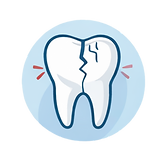
What is a Cracked Tooth?
What are
Cracked
Teeth?
Cracked teeth can cause sharp pain, biting discomfort, or temperature sensitivity, often without obvious signs on the surface. At Bloom Endodontics, we specialise in identifying cracks that extend into the inner tooth structure and managing their effects on the dental pulp. Early diagnosis and specialist care are key to relieving pain and preserving the natural tooth wherever possible.

A molar band is placed to stabilize a cracked tooth. This maybe switched to a crown if the symptoms on the tooth improve after a suitable observation period.
Management of a cracked tooth depends on the severity of symptoms and the condition of the dental pulp. In cases with mild symptoms and no signs of advanced pulp infection, a molar band may be placed initially to stabilise the tooth and assess whether symptoms improve. If pain settles, a full-coverage restoration such as a crown is then placed to protect the tooth long term

If the pulp is infected or symptoms do not improve with conservative treatment, root canal treatment and crack assessment is done prior to crown placement.
However, if pain persists or there are signs of significant pulp infection, root canal treatment is performed first. During treatment, the endodontist uses a dental microscope to assess the internal extent of the crack. Cracks that extend down the root of the tooth are known as root fractures and are generally associated with a poor long-term prognosis. Your endodontist may recommend replacing the tooth if a root fracture is detected.
How are Cracked Teeth Treated?
Care for a root canal treated cracked tooth is similar to that of a regular root canal treated tooth except for a few key differences.
It is extremely important to follow up promptly with your referring dentist for the definitive crown placement after endodontic treatment. Timely restoration helps stabilise the cracked tooth, prevent further fracture, and improve long-term outcomes.

A crown is placed to reinforce a cracked tooth.
Be mindful of excessive biting forces. Avoid chewing ice, hard nuts, or using your teeth to open packaging, as cracked teeth remain more vulnerable even after treatment.
Do attend follow-up appointments with your dentist or endodontist to monitor healing and ensure the crown is functioning well. If you notice persistent pain, swelling, or discomfort when biting, contact your clinic promptly.
With proper care, early crown placement, and regular dental reviews, many root canal–treated cracked teeth can function comfortably for years.
How should I Care for my Cracked Tooth?
What is Root Canal Retreatment?
If a previously treated tooth develops new symptoms or signs of infection, root canal retreatment may be needed. At Bloom Endodontics, we carefully remove the old root filling, clean and disinfect the canals, and reseal the tooth using advanced microscopes and specialised instruments. Our aim is to eliminate infection, relieve discomfort, and preserve your natural tooth wherever possible.
Modern endodontic treatments have high success rates. Despite this, they can still fail, resulting in persistent inflammation in the surrounding bone that is usually accompanied with signs and symptoms of pain and swelling.
Some possible reasons for endodontic retreatment may include:
1) Persistent infections that arise due to resistant bacterial strains, or the presence of hard-to-reach regions in the tooth where bacteria may remain despite the first round of endodontic treatment
2) New root canal infections that form due to defective fillings, cracks or fractures that allow bacteria to re-enter the root canal spaces
3) Foreign bodies or cysts being present around a tooth
When endodontic treatment fails, a tooth can undergo further treatments such as non-surgical retreatment or surgical endodontic treatment to try and treat the underlying disease. Your endodontist may perform further investigations such as taking a 3-dimensional x-ray scan of the tooth to better assess what type of treatment is more suitable for you.
Why does a Tooth Sometimes Require Another Round of Endodontic Treatment?
Depending on the reason why retreatment is needed, it maybe done through a non-surgical or surgical approach.
Non-Surgical Retreatment
Non-surgical root canal retreatment involves removing existing root canal filling materials, re-cleaning and re-shaping the root canals, and re-filling the root canal. This option is more predictable if there is an inadequacy of the existing root canal treatment which can be improved upon. Examples of this maybe when a root canal was missed during the first treatment or if there is new decay on the tooth which has caused the root canal filling to become contaminated.

Surgical Endodontic Retreatment (Apicoectomy)
Removing existing root canal filling materials non-surgically can sometimes be challenging and may not always be possible due to the risks involved. In such cases, surgical root canal therapy maybe an option. Surgical treatments may also be more suitable than non-surgical treatments to treat the following:
1) Infections that persist despite non-surgical root canal treatments that appear to be well performed
2) Teeth that are suspected to have cracks on the root surface which cannot be seen non-surgically
3) Teeth that are suspected to have cysts or lesions around them such as tumours
4) Teeth with damage to the root surface which cannot be accessed adequately using a non-surgical approach

Surgical root canal therapy is usually performed with an incision to the gums to expose the underlying infected tissue. These tissues are removed and the infected roots of the tooth treated from the bottom-up with surgical instruments and placement of a root-end filling prior to re-positioning and securing the gums with stitches. This procedure is usually termed an apicoectomy.
How is Non-Endodontic Retreatment Performed?
Depending on the cause of the infection, other less commonly used surgical procedures maybe considered such as autotransplantation, intentional replantation, and perforation or resorption repair:
1. Autotransplantation
This involves removing a donor tooth from one area of the mouth and transplanting it into another site to replace a missing or compromised tooth. Donor teeth are typically those already planned for extraction, such as premolars removed for orthodontic treatment or wisdom teeth.
2. Intentional Replantation
In this procedure, a diseased tooth is carefully removed along with surrounding infected tissue. The tooth is treated outside the mouth, usually from the root end, before being replanted into its original position and stabilised. This approach is considered when conventional apicoectomy is not feasible (for example, in teeth positioned far back in the mouth) and when root anatomy allows safe removal without a high risk of the tooth fracturing.
3. Perforation or Resorption Repair
This procedure typically involves making a small incision in the gum and removing a limited amount of bone to access the area of the tooth that has been perforated or damaged. The affected portion and any infected tissue are carefully removed. The defect is then sealed with a smooth biocompatible filling material to reconstruct the tooth and support healing of the surrounding tissues.
Are there other types of Endodontic Surgery?
Vital pulp therapy refers collectively to a group of conservative dental treatments that are aimed at preserving the health of the tooth’s pulp when it has been affected by decay or trauma but is still alive. By removing only the damaged tissue and placing a protective biocompatible material over the pulp, this procedure encourages healing and continued root development while maintaining the tooth’s natural vitality. Vital pulp therapy helps relieve symptoms, prevents further infection, and allows patients to keep their natural teeth whenever possible.
Vital pulp therapy can be broadly classified into procedures that go near to the pulp without exposing it, or those that involve treatment of the pulp tissue itself.
Vital pulp therapy is a more conservative procedure and preserves tooth structure, making the tooth less likely to break or fracture over time.
Vital Pulp Therapy not Exposing the Pulp
These can usually be done when the symptoms on the tooth are mild and indicate the pulp is capable of recovering with conservative treatment.
The procedure involves the following:
-
Bacteria within the cavities which are causing the pulp inflammation are removed. If there is a risk of exposing the pulp during the procedure, the deepest layer of decay maybe left unremoved and inactivated with a special medication that is left in the cavity.
-
Sealing of the cavity is done with a dental filling to minimise risk of re-infection of the dental pulp.
-
The filling surface is smoothened to make it easy to keep clean so as to reduce the risk of new decay forming at the same area.


A patient presents with deep decay on the upper right premolar is seen extending near to the pulp on an x-ray (blue arrows).

The decay is removed and the unhealthy pulp tissue removed, leaving behind healthy uninflamed pulp tissue.

A special biocompatible material is placed over the pulp tissue to seal it and promote healing.

The tooth is restored with a filling to help reconstruct the surfaces damaged by the tooth decay.
Vital Pulp Therapy involving the Pulp Tissue
In situations where the pulp is exposed or bacteria have already entered the pulp (for example, through deep decay or fractures), vital pulp therapy can be carried out to remove the infected and inflamed pulp tissue with the goal of leaving behind healthy pulp tissue that is able to heal and recover. This can be carried out if the signs and symptoms on the tooth suggest that the pulp is alive and inflammation has yet to spread through the entirety of the dental pulp.
The procedure involves the following:
-
Bacteria within the tooth cavity is removed.
-
Part of the inflamed pulp tissue is resected to remove the inflamed portion of the dental pulp, whilst preserving the healthy portion.
-
Sealing of the remaining healthy pulp tissue is done with a special biocompatible material that promotes healing of the pulp.
-
Sealing the cavity to minimise risk of re-infection of the dental pulp
-
Sealing of the cavity is done with a dental filling to minimise risk of re-infection of the dental pulp.
-
The filling surface is smoothened to make it easy to keep clean so as to reduce the risk of new decay forming at the same area.
A pulpotomy can have high success rates when performed under ideal conditions, however, it is a time-sensitive procedure. In the event that the pulp inflammation persists even after the pulpotomy is completed, root canal treatment may still be performed on the same tooth to remove the remaining inflamed pulp.
Vital pulp therapy is a time-sensitive procedure and cannot be performed once the pulp is severely infected or dead.
What & How is Vital Pulp Therapy Performed?

What is Vital
Pulp Therapy?
Vital pulp therapy is a conservative treatment performed at Bloom Endodontics that is designed to preserve the health of a living tooth affected by decay or trauma. By removing only damaged tissue and placing a protective biocompatible material, we encourage natural healing while maintaining the tooth’s vitality — helping patients relieve symptoms, prevent infection, and keep their natural teeth whenever possible.

What is Dental Trauma?
Dental injuries can occur without warning. Whether from a fall, sports accident, or sudden impact, teeth can become chipped, loosened, or even completely displaced in moments. With swift and appropriate treatment, many of these teeth can often be preserved. At Bloom Endodontics, we provide comprehensive care for dental trauma, from urgent intervention to long-term restoration. Our specialist team combine advanced imaging with modern, evidence-based techniques to support healing and maximise the chances of saving your natural tooth.
Traumatic dental injuries occur when sudden force or impact damages the teeth, surrounding bone, or soft tissues. These injuries can range from small chips to teeth being completely displaced from their sockets.
Common forms of dental trauma include:
-
Cracked or broken teeth
-
Teeth that have shifted out of position (luxation)
-
Teeth that have been knocked out (avulsion)
-
Fractures involving the tooth root
-
Injuries to the gums or lips
-
Damage to the jawbone
Because every injury is different, treatment must be carefully tailored. At Bloom Endodontics, we focus on personalised care with one goal in mind — preserving your natural tooth whenever possible.
What is Dental
Trauma?
Immediate Management
Quick action can greatly improve the chances of saving your tooth and this starts at the scene of the accident. Take the following steps to increase the odds of recovering quickly with minimal complications.
If a tooth is completely knocked out (avulsion):
-
Hold the tooth by the crown only — avoid touching the root.
-
Do not scrub or wipe the root.
-
If dirty, rinse gently with milk or saline (not water).
-
If possible, carefully reinsert the tooth into the socket and hold it in place.
-
If reinsertion isn’t possible, store the tooth in milk, saliva (inside the cheek), or a tooth preservation kit.
-
Seek emergency dental care within 30–60 minutes.
For broken or loose teeth:
-
Collect any tooth fragments if available.
-
Avoid chewing on the affected side.
-
Apply a cold compress to reduce swelling.
-
Seek emergency dental care within the same day.
Help! I Just Experienced Dental Trauma. What Should I Do?
1. Individualised Care for Dental Trauma
No two dental injuries are exactly alike. A thorough assessment of the degree of dental injury is made to allow each patient to receive a tailor-made, specialist-managed treatment plan designed to support healing and preserve natural teeth whenever possible.
2. Comprehensive Assessment & Advanced Imaging
A thorough clinical examination is performed, supported by digital X-rays or 3D scans to clearly identify the extent of trauma, including any damage beneath the surface of the tooth.
3. Repositioning and Stabilisation
If a tooth has shifted or been knocked out, it will be gently guided back into place and secured using appropriate splinting techniques. Acting quickly plays a vital role in successful recovery.
4. Root Canal Treatment (When Required)
Should the inner pulp tissue be affected, root canal treatment may be recommended to remove infection and protect the tooth. Depending on the injury, this may be performed immediately or planned at a later stage.
5. Ongoing Review and Monitoring
Trauma can have delayed effects, which is why follow-up visits are arranged over several weeks or months. These appointments allow for monitoring of healing and early detection of potential complications such as pulp damage or root changes.
6. Final Restoration and Smile Rehabilitation
Once the tooth is stable, we collaborate closely with your general or paediatric dentist to complete the restorative phase — which may include fillings, crowns, or veneers — restoring both appearance and function.
How is Dental Trauma Managed at the Dental Clinic?
Caring for Your Teeth During the Healing Phase
-
Refrain from biting or chewing on the treated teeth until any stabilisation splint has been removed from your teeth (usually 2 to 4 weeks later).
-
Choose soft foods and steer clear of hard or sticky items such as nuts, hard breads, apples, or chewy sweets.
-
Keep your mouth clean by brushing gently with a soft-bristled toothbrush, especially around the splinted area.
-
Rinse twice daily with an antiseptic mouth rinse or warm salt water to help soothe the gums and minimise inflammation.
-
Avoid touching or moving the injured teeth.
Supporting Recovery
-
Skip contact sports or vigorous activities until your endodontist explicitly clears you for it.
-
Consider wearing a custom-made mouthguard for future sports to protect your teeth.
-
Attend all scheduled review visits so that your healing progress can be closely monitored and any complications can be detected and managed early.